Skip to content
Private Akutklinik · Bad Herrenalb Mo–Fr 8:00–16:30 Uhr · Kontaktaufnahme rund um die Uhr

Personality Disorders.

A person's personality is an expression of their individuality and encompasses all their character traits and attributes. In a psychiatric-psychological sense, the concept of "personality" is to be understood dimensionally, ranging from a particular personality style through a possible personality accentuation to a manifest personality disorder.

Inpatient treatment · Privately insured · Beihilfe · Self-payers

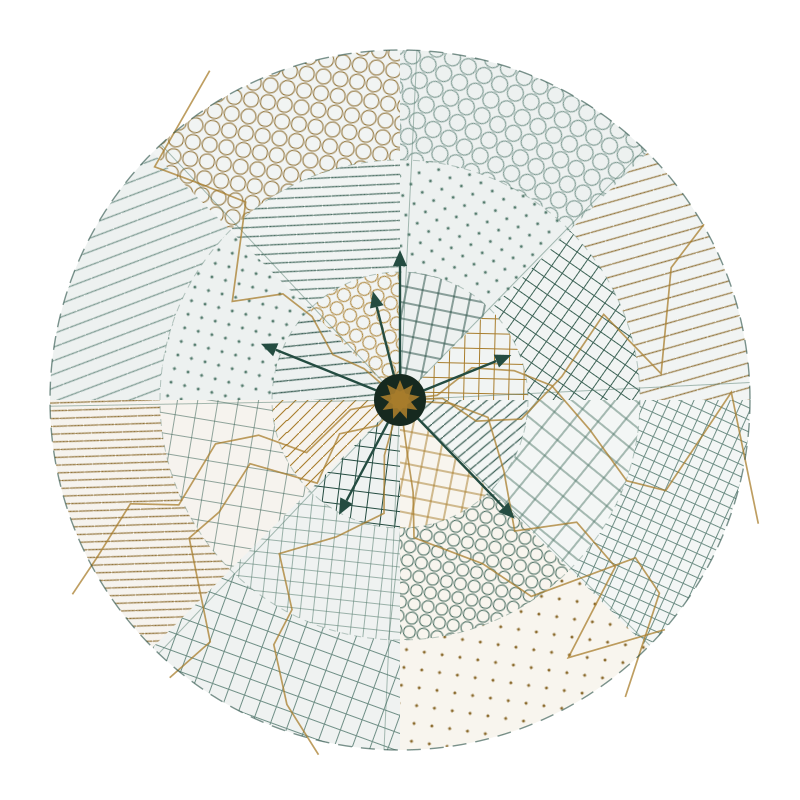
Mandala for personality disorders: rigid structures without a centre
The disrupted structure
General populationapprox. 9%

according to current data in Germany.

In psychiatric treatment40–60%

considerably higher in the group of patients receiving psychiatric treatment.

When patterns become entrenched.

In people with personality disorders, certain features of their personality and their relational and behavioural patterns are particularly pronounced and inflexible. These are deeply rooted, enduring patterns of experience, typically shaped in childhood, present since adolescence and manifest since adulthood, which manifest as rigid responses to a variety of personal and social circumstances. People with personality disorders deviate persistently in their perception, thinking, feeling and manner of relating from the majority of people (in a comparable population group). Their patterns are stable, and they impair social relationships and ultimately lead to suffering not only for those affected, but frequently also for those around them. The prevalence of personality disorders in the general population is only partly established. According to current data, we estimate a prevalence of approximately 9% in Germany, though this is considerably higher at 40–60% in the group of patients receiving psychiatric treatment.

It is often reactive depressive symptoms (arising from conflicts, after separations, etc.), comorbid conditions (e.g. addiction disorders, eating disorders) or deliberate self-harming behaviour (self-injury, suicide attempts) that lead people with personality disorders to seek outpatient or inpatient psychiatric-psychotherapeutic treatment. On the basis of the reported symptoms, the clinical history, information from relatives, observed and experienced relational patterns, and with the aid of specific diagnostic instruments (SCID II, PSSI, etc.), a personality style, a diagnosis of personality accentuation or a personality disorder can be identified. In contrast to the assumption that this must be hurtful or shameful for those affected, we often find that the diagnosis can also bring great relief, in that those affected encounter for the first time an understanding and acceptance of what has persistently burdened themselves and/or those close to them, but which had hitherto been impossible to put into words or to place in context.

Common presentations.

The most common personality accentuations and personality disorders encountered in inpatient work are dependent, self-uncertain, narcissistic, obsessive-compulsive, histrionic and emotionally unstable (borderline), and less commonly schizoid, dissocial and paranoid. At our clinic, we work using a cross-method approach combining behavioural therapy, depth psychology and systemic perspectives. An integrative therapy concept makes it possible, within an intensive and relationship-rich process, to address a patient's relational and behavioural patterns in an indication-specific manner, either conflict-centred or structure-based, to understand biographical connections and to work through the inner conflicts and structural deficits present. This is possible both behaviourally (e.g. using schema therapy or specific manuals such as DBT for borderline), from a depth-psychological perspective (e.g. transference-focused) or systemically (couples and family sessions, in specialised group therapies). The aim is to "defuse" difficult or disturbed relational and behavioural patterns and ultimately to enable corrective relational experiences, which can then be transferred into everyday life — for which graduated stress tolerance exercises serve (see treatment concept). Treatment of personality disorders generally involves a psychotherapy process spanning several years, for which the inpatient setting lays initial foundations (acceptance of the illness, reduction of depressive symptoms, abstinence from alcohol or drugs, cessation of self-harming behaviour, stabilisation of affect regulation, improvement of self-awareness). For certain personality disorders and comorbid conditions (borderline PD, complex post-traumatic stress disorders, eating disorders, dependency issues), we work with individually developed therapeutic agreements, which define, among other things, the duration of treatment (often 8–12 weeks), realistic therapy goals, the management of symptoms (including the urge to self-harm), the therapeutic framework and the consequences of non-adherence to therapeutic agreements.

Treatment at Sanima Klinik.

In accordance with the severity of the symptoms and comorbid conditions (depressive affect, inner restlessness, tension, urge to self-harm, etc.), psychotropic medications are also used in the treatment of personality disorders. We provide our patients with comprehensive information about the indications, mechanisms of action and possible side effects of these medications (see treatment concept).

Häufige Fragen

Answers to frequently asked questions about personality disorders.

Patients, relatives and referring physicians regularly ask us recurring questions. The most important answers are summarised here.

01.How is a personality disorder recognised?

By enduring, inflexible patterns of experience and behaviour that repeatedly lead to conflicts and distress — often in relationships, at work or in dealing with criticism and closeness. Treatment is often sought only because of the consequences: depressive symptoms, crises or recurring relationship breakdowns.

02.Can personality disorders be treated?

Yes. Within a relationship-rich therapeutic framework — such as that provided by our primary therapist system — one's own patterns can be perceived, understood and gradually changed. Treatment is tailored to the severity of the symptoms and accompanying conditions.

03.Who covers the cost of treatment?

Admission is open to privately insured patients, persons entitled to government subsidy (Beihilfe) and self-payers. Some statutory health insurance funds (e.g. Techniker Krankenkasse and DAK) provide in their statutes for cost coverage, under certain conditions, for treatment at a purely private clinic up to the level of comparable rates at a hospital approved under § 108 SGB V. We are happy to advise you during the preliminary telephone consultation.

04.How do I arrange an admission consultation?

By telephone at +49 7083 748-0 (Mon–Fri 8:00–16:30) or via the callback service on the contact page. Our admissions office will respond within 24 hours with a suggested time for a detailed, no-obligation telephone consultation.

Quellen

Fachliche Grundlage der Inhalte.

  1. [1]S3 Guideline: Personality Disorders AWMF Guideline Registry (ed.). register.awmf.org — current guidelines
  2. [2]ICD-10-GM — Chapter V, F60/F61 (Personality Disorders) Bundesinstitut für Arzneimittel und Medizinprodukte (BfArM). bfarm.de — ICD-10-GM
  3. [3]Deutsche Gesellschaft für Psychiatrie und Psychotherapie, Psychosomatik und Nervenheilkunde (DGPPN) Specialist information. dgppn.de
Aufnahme

Sprechen Sie mit uns — persönlich, vertraulich, ohne Wartezeit.

Telefon · Aufnahme­büro
+49 7083 748-0
Aufnahme
Privatversichert · Beihilfe · Selbstzahler
Versicherte einiger gesetzlicher Krankenkassen (z. B. die Techniker Krankenkasse und die DAK) haben in manchen Fällen die Möglichkeit, eine Teilkostenerstattung durch die GKV zu erwirken.